
Tourism Tech
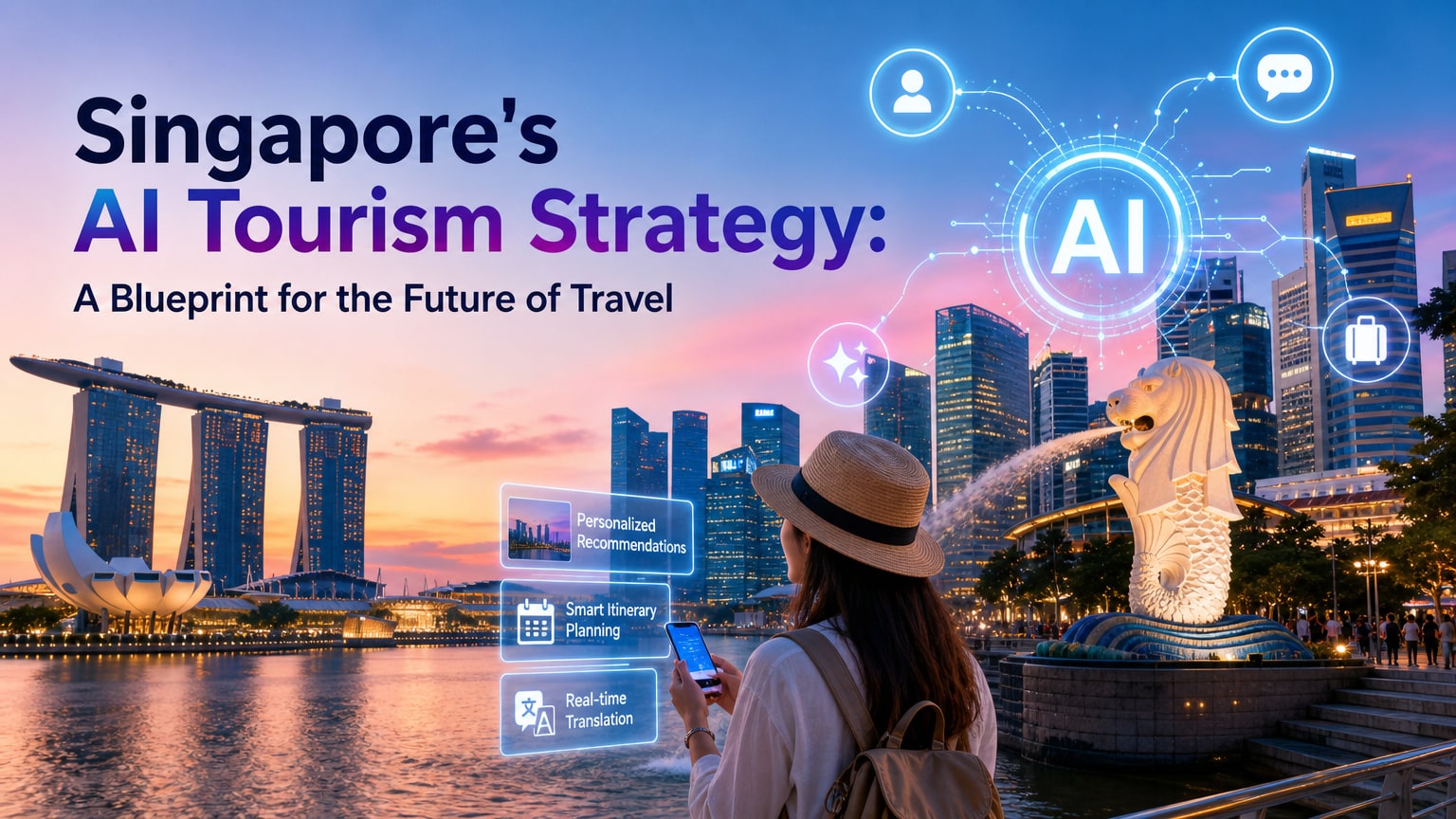
Singapore's AI Tourism Strategy: A Blueprint for the Future of Travel
Singapore is pioneering an innovative AI strategy to transform its tourism sector. This approach focuses on enhancing visitor experiences, improving operational efficiency, and fostering a future-ready industry through a phased AI adoption roadmap.
In an increasingly digital world, the integration of Artificial Intelligence (AI) into various sectors is no longer a futuristic concept but a present-day imperative.
Singapore, a global leader in innovation, is at the forefront of leveraging AI to revolutionize its tourism industry.
The Singapore Tourism Board (STB) has laid out a comprehensive AI strategy, moving beyond simple chatbots to create an interconnected ecosystem of AI agents. This strategic summary outlines their vision, immediate goals, and a practical roadmap for businesses to adopt AI effectively.
The Vision: Shaping Tourism with Purpose
The STB views AI as a dual capability: enhancing internal productivity and driving industry-wide transformation. The core principle guiding this vision is that while technology can redesign tourism, it's people who give it purpose. This human-centric approach ensures that AI serves to augment, not replace, human creativity and interaction.
Three Immediate Goals:
Understand Travellers Better: By transforming data into actionable insights, AI aims to create more meaningful and personalized experiences for visitors.
Improve Experiences: AI is utilized to design smarter, more seamless visitor journeys, anticipating needs and streamlining processes.
Work Smarter: AI acts as a practical work companion, building confidence in teams to move faster from information to action, thereby boosting efficiency.
The Strategic Arc: Building AI Capabilities
Singapore's AI strategy for tourism is built on a strategic arc that emphasizes continuous learning, practical adoption, and ecosystem-wide integration.
It begins with fostering AI literacy within the STB through initiatives like 'Learn Fest' and 'Brown Bag sessions'. For tourism businesses, the 'AI Playbook' and 'Tcube Centre of Excellence' provide a clear adoption path.
The strategy outlines a progression from isolated Generative AI (GenAI) tools to integrated workflows, cross-business coordination, and ultimately, autonomous AI ecosystems.
Foundational elements like data quality, governance, interoperability, security, and workforce adoption are prioritized, recognizing their critical role in successful AI implementation. Furthermore, the strategy prepares for AI-mediated discovery through Generative Engine Optimisation (GEO), ensuring tourism brands are discoverable in AI answers, complementing traditional Search Engine Optimization (SEO).
The AI Stack: From GenAI to Agentic AI
The STB's strategy categorizes AI capabilities along a spectrum:
Generative AI (GenAI): Creates new content (text, images, audio) from prompts, with human direction remaining central.
Copilots: Provide context-aware, task-oriented assistance to help users complete routine work.
Agentic AI: Plans, decides, and executes multi-step tasks across tools and workflows with minimal human input.
Embodied AI: AI integrated into physical entities like robots that interact with the physical world.
Artificial General Intelligence (AGI): A theoretical form of broad human-comparable intelligence, which currently does not exist.
The direction of travel is a clear progression from simple chatbots to sophisticated, interconnected AI agents, enabling a truly coordinated visitor journey.
The Future Visitor Journey: Coordinated AI Agents
The future vision for tourism in Singapore involves a significant shift from manual, disparate processes to an ecosystem of interoperable AI agents. Imagine a scenario where rebooking a flight automatically triggers a series of AI agents that notify hotels, drivers, and attractions, adjusting itineraries seamlessly. Contingency options, such as alternative transport or airport hotels, could be proposed proactively.
This long-term model places a strong emphasis on integration standards, trusted data exchange, and cross-business coordination, all crucial for future competitiveness. The goal is a truly coordinated service across all tourism businesses, adapting in real-time to changes like weather or capacity.
What Success Looks Like: Tangible Benefits of AI
The successful implementation of this AI strategy is expected to yield significant benefits:
AI-powered Insights: Combining real-time IoT data, staff availability, and visitor schedules to optimize task allocation, leading to potential productivity gains.
Operational Efficiency: Agentic automation of repetitive workflows, such as staffing optimization and service fulfillment, potentially leading to substantial operational cost reductions.
Visitor Discovery & Personalisation: AI-powered tools will enhance how travelers research and book destinations, making it critical for tourism brands to be discoverable within AI planning and search experiences.
GEO: Being Discoverable in the AI Era
With travelers increasingly using GenAI for trip planning and recommendations, the concept of Generative Engine Optimisation (GEO) becomes paramount. Unlike traditional SEO, which focuses on keywords and site performance, GEO prioritizes schema data, natural language, and concise formats. Success in GEO is measured by the frequency of mentions and citations in GenAI answers, directly influencing brand perception even before a visitor reaches a website. The STB emphasizes that GEO complements, rather than replaces, traditional SEO.
The Four-Phase AI Roadmap
The STB outlines a staged path for AI adoption, from simple tools to an 'Internet of Agents':
Nascent: Utilizing ready-made GenAI tools in daily work with minimal technical setup.
Optimised: Connecting internal systems and automating end-to-end workflows with GenAI and Agentic AI.
Connected: AI working across businesses and industries, coordinating services and adapting in real-time.
Transformational: Autonomous AI agents planning, executing, and optimizing across the entire tourism ecosystem with minimal human initiation, a phase projected beyond 2035.
How Businesses Can Start Their AI Journey
The STB provides clear recommendations for businesses looking to embark on their AI adoption journey:
Adopt Off-the-Shelf Solutions: Begin with common functions like marketing, sales, and customer engagement using established chatbots, CRM systems, and content tools.
Prioritise Industry Use Cases: Focus on high-value applications with measurable business impact, such as guest personalization or workflow automation.
Utilise Programmes and Support: Leverage available training, innovation programs, workshops, and grants to reduce adoption risk and accelerate capability building.
The operating rule is to start with measurable value, not necessarily the most advanced technology.
Key Considerations for Responsible AI Adoption
Responsible AI adoption is a critical aspect of Singapore's strategy. The STB highlights six key considerations:
Business Problem: Identify where AI can deliver the most business value.
Data Readiness: Ensure data is usable, accurate, standardized, and governed.
Technology & Architecture: Decide whether to build, buy, integrate, or partner for AI solutions.
Governance & Risk: Address privacy, accuracy, copyright, security, and responsible-use risks.
Interoperability: Ensure systems can integrate with others to avoid vendor lock-in.
Change Management: Plan for how staff will learn, trust, adopt, and embed AI into daily work.
Ultimately, Singapore's AI tourism strategy offers a robust framework for any destination looking to harness the power of AI. By focusing on a phased approach, responsible adoption, and a human-centric vision, they are setting a precedent for a more intelligent, efficient, and personalized future for travel.
- #singapore
- #ai
- #tourism
- #strategy
- #innovation
- #travel
- #digital transformation
- #generative ai