
Malaysia Tourism
Malaysia’s Tourism Has Recovered. But Are Local Tourism Players Capturing the RM236.9 Billion Opportunity?
Malaysia’s Tourism Has Recovered. But Are Local Tourism Players Capturing the RM236.9 Billion Opportunity? By Uzaidi Udanis AI Inbound Tourism Strategist | Founder, Your Inbound Matters | Co-Founder…
Malaysia’s Tourism Has Recovered. But Are Local Tourism Players Capturing the RM236.9 Billion Opportunity?
By Uzaidi Udanis
AI Inbound Tourism Strategist | Founder, Your Inbound Matters | Co-Founder & CICO, Asnirez
Malaysia’s tourism industry has recovered.
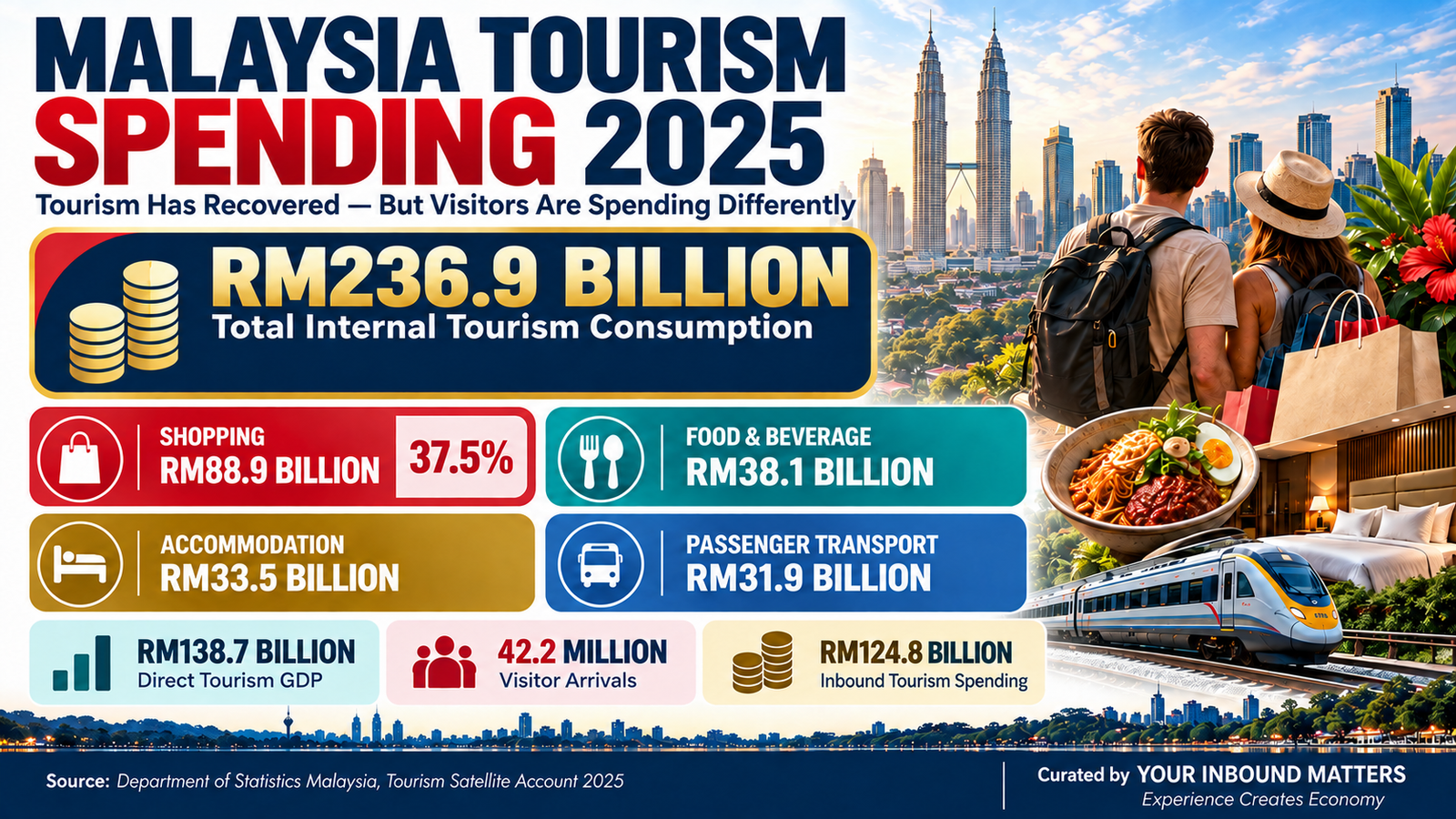
According to the Department of Statistics Malaysia (DOSM), internal tourism expenditure reached RM236.9 billion in 2025. Tourism also contributed RM138.7 billion directly to Malaysia’s economy.
These are impressive numbers. But as someone who has spent many years in inbound tourism, I believe we need to ask a more important question:
How much of this spending is actually reaching our local tourism players?
It is good to celebrate visitor arrivals. But arrivals alone do not pay the bills. Tourism businesses earn when visitors spend on accommodation, food, transport, shopping, tours and experiences.
The latest numbers show that tourists are still spending—but they are spending differently.
Where did the RM236.9 billion go?
The RM236.9 billion represents internal tourism expenditure. This combines spending by international visitors in Malaysia and domestic visitors travelling within the country.
The largest categories were:
Shopping: RM88.9 billion
Food and beverage: RM38.1 billion
Accommodation: RM33.5 billion
Passenger transport: RM31.9 billion
Shopping alone captured 37.5% of the total.
This tells us something important. The tourism economy is much bigger than hotels, flights and traditional tour packages. It includes restaurants, markets, shops, transport providers, guides, artisans, activity operators and local communities.
Visitors may stay for a shorter time, but they are still ready to spend when we offer something relevant, convenient and easy to buy.
What about tours and local experiences?
DOSM does not publish one specific category called “local experiences.” However, two categories give us the closest indication:
Travel agencies and other reservation services
Cultural, sports and recreational services
International visitors spent approximately:
RM7.38 billion on travel agencies and other reservation services
RM6.04 billion on cultural, sports and recreational services
Together, these categories were worth approximately RM13.42 billion, or 10.7% of Malaysia’s RM124.84 billion in inbound tourism expenditure in 2025.
When domestic tourism is included, the two categories were worth approximately RM18.24 billion, equal to about 7.7% of the RM236.9 billion in total internal tourism expenditure.
We must explain this carefully. The RM13.42 billion is not an exact measurement of local-experience sales. These DOSM categories are broader. They can include agency services, reservations, attractions, cultural activities, sports and recreation. Some parts of a tour or experience may also be recorded under food, transport, accommodation or shopping.
But the message is still powerful:
Malaysia already has a multibillion-ringgit tours-and-experiences economy.
The opportunity exists. The question is whether local tourism players are positioned to capture it.
More visitors do not automatically mean more business
Malaysia recorded 42.2 million visitor arrivals in 2025. Of these, approximately 26.6 million were overnight tourists and 15.6 million were same-day visitors.
A same-day visitor may not book a hotel, but that visitor can still:
join a food trail;
attend a cooking class;
visit a local market;
book a craft workshop;
hire a guide;
take a cycling or scooter tour;
enjoy a wellness treatment;
buy local products; or
participate in a two-hour cultural experience.
This is why we cannot measure tourism success using hotel occupancy and arrival numbers alone.
We must also measure what visitors buy, where they spend and how much of that money reaches local businesses and communities.
The gap is not a lack of attractions
Malaysia has no shortage of assets.
Every state has food, stories, traditions, villages, crafts, farms, nature, heritage and talented local people. The real gap is turning these assets into experiences that visitors can discover, understand and book.
A paddy field is an asset. A guided paddy-farming experience is a product.
A traditional kitchen is an asset. A three-hour cooking experience hosted by a local family is a product.
A craftsperson is an asset. A workshop where visitors make and bring home their own souvenir is a product.
An asset becomes part of the tourism economy only when it is packaged, priced, presented and made available for purchase.
This is what I mean when I say:
Experience Creates Economy
When we create a bookable experience, we create more than an activity.
We create income for the host. We create work for guides and drivers. We create demand for local food and products. We give visitors a reason to stay longer, spend more and recommend Malaysia to others.
Seven actions tourism players can take now
1. Follow visitor spending, not only visitor arrivals
Study what visitors are already buying. Shopping and food are the two biggest opportunities. Build experiences around those existing behaviours.
Do not offer only a meal. Offer a story, a host and an activity around the meal.
Do not sell only a souvenir. Let the visitor meet the maker or create something themselves.
2. Start with one strong experience
You do not need 20 products to begin.
Create one experience with a clear customer, story, itinerary, duration and price. Test it with real guests. Improve it before developing more products.
One bookable product is more valuable than ten ideas that remain inside a WhatsApp conversation.
3. Design for shorter visits
Not every visitor has a full day. Create two-hour, three-hour and half-day experiences for transit passengers, business travellers, event visitors and same-day visitors.
Make the starting time, meeting point and transportation requirements clear.
4. Become visible, bookable and AI-ready
Visitors now search using Google, online marketplaces, social media and AI platforms. Your product information must be clear and consistent wherever they search.
State exactly what the visitor will do, who will host them, how long it takes, what is included, how much it costs and how to book.
If visitors cannot find your experience or confirm it immediately, they will move to another option.
5. Connect food, shopping and experiences
The spending categories should not operate separately.
A heritage walk can finish at a local restaurant. A cooking class can include a market visit. A craft workshop can provide a product for the visitor to take home. A homestay can offer fishing, cycling, traditional wellness or a village breakfast as paid add-ons.
This increases visitor spending while allowing more local businesses to benefit.
6. Use both direct-to-consumer and B2B distribution
Do not depend on only one sales channel.
Build your own customer database and direct-booking capability. At the same time, work with hotels, travel agents, destination management companies, marketplaces and international partners that can bring customers to you.
Owning the product does not mean selling it alone.
7. Measure the money that stays locally
Track more than views, likes and enquiries.
Measure bookings, average customer spending, repeat referrals, commissions paid to local partners and the number of people earning from each experience.
That is how we know whether tourism is truly creating an economy for the community.
The opportunity for Malaysian tourism players
The RM236.9 billion figure should not be treated only as a national success story. It should be seen as a market signal.
Tourists are spending. But the spending is moving across shopping, food, transport, activities and many smaller transactions throughout the journey.
For tourism players, the question is no longer:
“Are tourists coming to Malaysia?”
The better question is:
“Is my business giving them something meaningful that they can find, book and buy?”
Malaysia has already recovered the size of its tourism economy. Our next job is to improve the quality and distribution of that economy—so that more local operators, young people, entrepreneurs and communities can participate.
Start with one local asset.
Turn it into one clear experience.
Make it visible. Make it bookable. Connect it to the market.
Experience Creates Economy.
About the author
Uzaidi Udanis is an AI Inbound Tourism Strategist, Founder of Your Inbound Matters, and Co-Founder and Chief Industry & Community Officer of Asnirez. He works with tourism businesses, destinations and communities to transform local assets into visible, bookable and market-ready tourism experiences.
Sources and data note
Department of Statistics Malaysia, Tourism Satellite Account 2025, released 15 September 2026. DOSM labels the 2025 figures as provisional.
SAYS: “Malaysia’s Tourism Industry Has Fully Recovered, But Tourists Are Spending Differently Now”, published 15 September 2026.
- #Ai Inbound Tourism
- #tourism receipt