
AI & Inbound Tourism
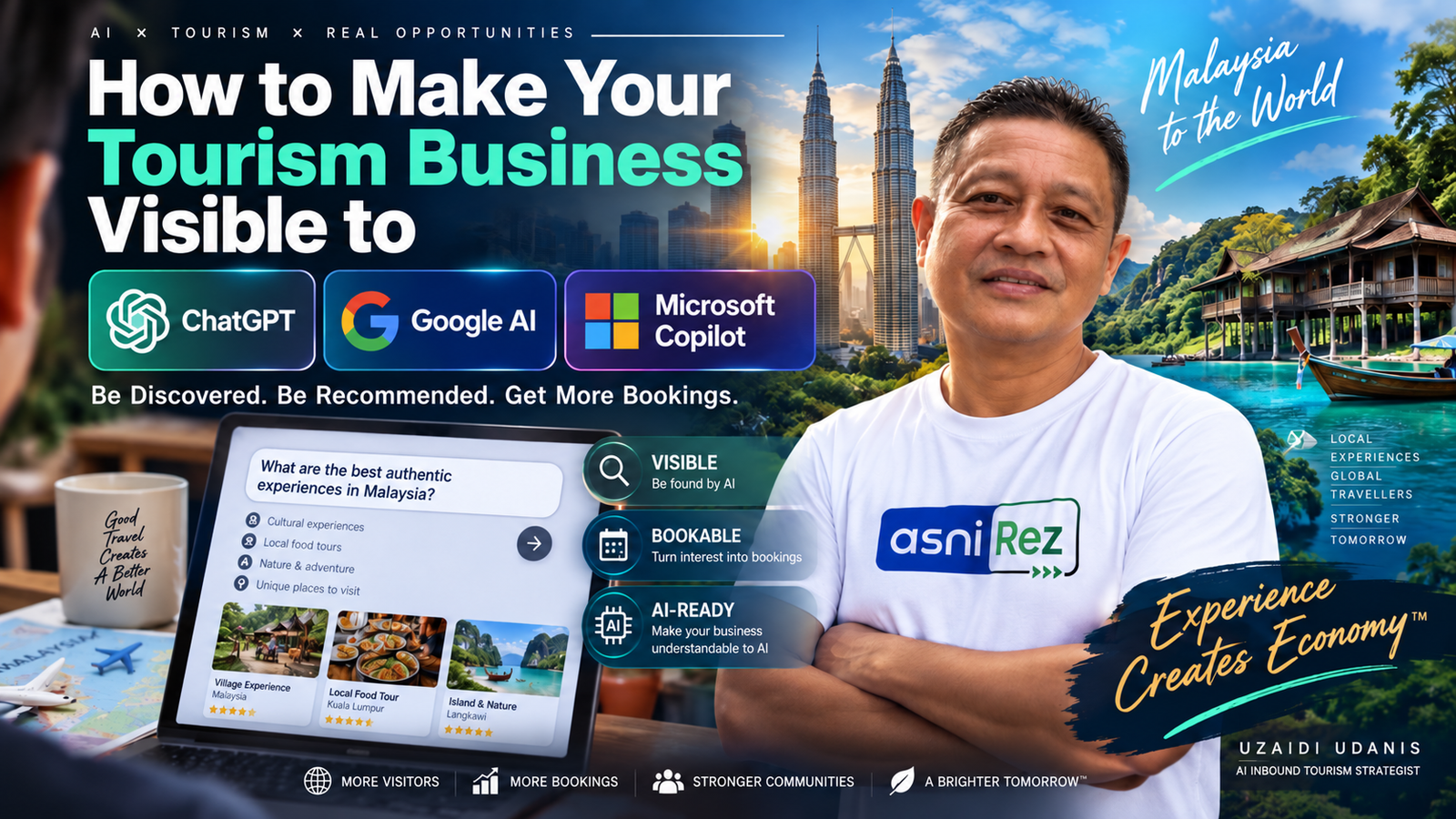
How to Make Your Tourism Business Visible to ChatGPT, Google AI & Copilot
Learn how tourism businesses can improve visibility in ChatGPT, Google AI and Microsoft Copilot by becoming clear, crawlable, credible, bookable and AI-ready.
How to Make Your Tourism Business Visible to ChatGPT, Google AI and Microsoft Copilot
Salam and hello everyone . How was your weekend ?
Today , I will be sharing on AI Tourism strategies…
Why is it important ?? …. Because
If AI cannot understand your tourism business, it may never recommend you.
why is it important for Ai to understand you ???
A traveller is sitting in London planning a trip to Malaysia.
He does not search:
“Malaysia tour package.”
Instead, he asks:
“I have four days in Malaysia. I want authentic local experiences, good food, nature and something my children will remember. What should I book?”
That question may now be asked through ChatGPT, Google AI or Microsoft Copilot.
And that changes the game for tourism businesses.
The question is no longer only:
“Do I rank on Google?”
The new question is:
“Can AI find, understand and trust my business enough to mention it?”
That is the new tourism visibility challenge.
Welcome to the Age of AI Discovery
For years, tourism businesses concentrated on websites, Facebook, Instagram, Google search and online travel marketplaces.
All of those still matter.
But traveller behaviour is changing.
People increasingly want answers, not hundreds of links.
They may ask:
“What are the best local food experiences in Kuala Lumpur?”
“Where can I experience village life in Malaysia?”
“What should I do in Langkawi besides the beach?”
“Recommend a unique Malaysian cultural experience.”
“What can I book near KLIA before my evening flight?”
AI can interpret these questions and recommend places, experiences and businesses.
So the tourism industry is entering a new competition:
The competition to be understood by AI.
First, Understand This: There Is No Magic “Submit to ChatGPT” Button
Many tourism operators ask me:
“How do I register my company with ChatGPT?”
That is not really how it works.
Public websites can appear in ChatGPT search, but OpenAI says website owners should make sure they are not blocking OAI-SearchBot, its search crawler.
Google similarly continues to rely on the fundamentals of good search visibility for its AI-powered search experiences.
Microsoft has gone even further: Bing Webmaster Tools now provides an AI Performance report showing which pages from a website are cited in Microsoft Copilot and other AI-generated answers.
So there is no shortcut.
You have to build a digital presence that machines can understand.
Think Like AI
Imagine you operate a small village cooking experience.
Your Facebook page says:
“Come join us. Very interesting activity. PM for details.”
From a human perspective, maybe that is enough to start a conversation.
From an AI perspective, there are many unanswered questions.
What is the experience?
Where is it?
How long does it take?
Who operates it?
What food will visitors cook?
How much does it cost?
Is it suitable for families?
What language is spoken?
How can someone book?
Why is it special?
AI works better when these answers exist clearly online.
That is why the first rule of AI visibility is:
Clarity beats creativity.
You can have beautiful branding.
But if nobody — including AI — can understand what you sell, the branding will not save you.
1. Clearly Explain Who You Are
Your website should clearly state:
Business name
Location
What you offer
Who it is for
What makes it different
How to book
Do not make visitors search through five pages to understand your business.
Your homepage should be able to answer a simple question:
“What exactly does this company do?”
For example, instead of:
Welcome to ABC Travel & Services
try:
ABC Travel & Services is a Malaysian inbound tour operator specialising in private cultural, food and nature experiences for international travellers visiting Kuala Lumpur and Selangor.
Suddenly both humans and machines understand much more.
2. Stop Selling Everything
One of the biggest mistakes I see in tourism is this:
“We provide all tourism services.”
Airport transfer.
Hotel.
Ticket.
Car rental.
Tour.
Food.
Shopping.
Cruise.
MICE.
Visa.
Everything.
The problem?
Nobody knows what you are actually good at.
AI visibility becomes stronger when your positioning is clear.
Instead of being:
“A travel company in Malaysia”
you might become:
“A specialist in authentic Malay village experiences near Kuala Lumpur.”
Or:
“A family-focused nature and cultural tour operator in Selangor.”
Or:
“A local food experience specialist for international visitors to Penang.”
Specificity helps people remember you.
It also helps machines understand you.
3. Create Individual Pages for Your Experiences
Do not put 20 different products on one giant page.
Create a dedicated page for each important tourism experience.
For example:
Malay Village Cooking Experience
Kuala Lumpur Sunrise E-Scooter Experience
Traditional Malaysian Craft Workshop
Farm-to-Table Durian Experience
Kampung Cycling & Breakfast Experience
Each page should clearly explain:
experience name
location
duration
itinerary
price or price range
inclusions
exclusions
meeting point
operating days
target customer
accessibility considerations
photographs
booking method
FAQs
That page becomes a very strong unit of information.
It is much easier for search engines and AI systems to understand one clearly defined experience than a vague company page.
4. Write for Questions Travellers Actually Ask
Traditional SEO often focused heavily on keywords.
AI discovery pushes us toward questions and intent.
Instead of creating only an article called:
“Melaka Tourism”
you could create:
“What Are the Best Authentic Village Experiences Near Melaka?”
Or:
“What Can Families Do in Melaka Besides Visiting Jonker Street?”
Or:
“Where Can International Visitors Experience Traditional Malaysian Cooking?”
Why?
Because these are closer to how people speak to AI.
Microsoft specifically recommends aligning content with user intent and using clear structure, descriptive headings, useful examples and supporting evidence if you want your content to be useful in AI-generated answers.
5. Build Topical Authority
One article is not enough.
If you want AI systems to associate your business with a subject, create useful content around that subject consistently.
Imagine you operate a cooking experience in Kelantan.
You could publish:
What Is Nasi Kerabu?
How Nasi Kerabu Is Traditionally Prepared
The Herbs Used in Nasi Kerabu
Kelantan Food Culture for First-Time Visitors
Can Tourists Learn to Cook Nasi Kerabu in Malaysia?
Best Food Experiences in Kelantan
Now your website is no longer simply selling a cooking class.
It is becoming a useful source about Kelantan food culture.
That is much stronger.
6. Use Real Expertise, Not Generic AI Content
This point is extremely important.
Do not publish 100 articles that sound like they were written by the same AI template.
If everybody can produce the same article, why should an AI system cite yours?
Add information only you know.
Real examples.
Real customer questions.
Local knowledge.
Original photographs.
Your own research.
Your own data.
Actual operating information.
Industry experience.
Interviews.
Case studies.
For example:
Instead of writing:
“Malaysia has many beautiful villages.”
write:
“When we tested this village experience with six international visitors, the activity they spent the most time on was not the main attraction. It was sitting with the host family while learning how traditional coffee was prepared.”
That is original.
That is experience.
That is useful.
7. Make Your Business Bookable
AI visibility without bookability can still end in zero revenue.
Imagine AI recommends your experience.
The traveller clicks.
Then sees:
“WhatsApp us for price.”
They ask the price.
You reply three hours later.
Then they ask availability.
Then payment method.
Meanwhile they have already booked somebody else.
Tourism businesses need to reduce friction.
Ideally, customers should be able to understand:
What can I book?
When?
How much?
What is included?
How do I pay?
That is why I repeatedly use the phrase:
Visible → Bookable → AI-Ready
Visibility creates the opportunity.
Bookability converts the opportunity.
8. Make Sure Your Site Can Actually Be Crawled
This sounds technical, but it is essential.
Your beautiful content is useless to search systems if their crawlers cannot access it.
For ChatGPT search, OpenAI recommends ensuring that OAI-SearchBot is not blocked in your robots.txt.
For Bing and Microsoft Copilot, make sure Bing can crawl and index your site. Microsoft recommends using Bing Webmaster Tools, sitemaps and tools such as IndexNow to help search engines discover updated pages.
Your developer should check:
robots.txt
XML sitemap
noindex tags
canonical URLs
page load accessibility
server response codes
mobile usability
structured data
You do not need to understand every technical detail yourself.
But somebody on your team should.
9. Use Structured Data
Structured data helps machines understand the meaning of information on your website.
Depending on your business, useful schema can include:
Organization
LocalBusiness
Person
Article
Product
Event
FAQ-related content where appropriate
The important thing is accuracy.
Do not add information in structured data that is not genuinely reflected on the page.
Google continues to emphasize that structured data should accurately represent visible content.
10. Build Trust Beyond Your Own Website
Anybody can say:
“We are the best tour operator in Malaysia.”
That does not make it true.
Stronger signals come when other credible sources mention you.
For tourism businesses, that might include:
tourism associations,
media articles,
destination websites,
industry directories,
travel marketplaces,
Google Business Profile,
customer reviews,
partner websites,
event pages,
YouTube interviews,
conference profiles.
Think of it this way:
Your website says who you are.
Other websites help confirm it.
11. Keep Your Information Consistent
Imagine your business appears online as:
ABC Holidays
on one website.
ABC Travel
somewhere else.
ABC Tours Malaysia
on Facebook.
Different phone numbers.
Different addresses.
Different product descriptions.
This creates confusion.
Use consistent information wherever possible:
Business name
brand description
location
contact details
website
social profiles
founder or operator
product names
Consistency makes it easier for machines to connect information about the same entity.
12. Create Content Worth Citing
This is perhaps the biggest opportunity.
Instead of only asking:
“How do I get AI to recommend my business?”
ask:
“What information can I publish that AI would actually find useful?”
For example, a hotel could publish:
The Best Early-Morning Things to Do Near KLIA
A local guide could publish:
A Local’s Guide to Kampung Baru Food
A homestay could publish:
What Is It Really Like to Stay in a Malaysian Village?
A destination organisation could publish:
50 Bookable Local Experiences in Perlis
A tour operator could publish:
A 7-Day Halal-Friendly Malaysia Itinerary for Families
These articles solve genuine traveller problems.
That makes them more valuable than another generic advertisement.
An Example: The Traditional Bladesmith
Imagine a Malaysian bladesmith offers visitors the chance to make a traditional parang.
If almost nothing exists online, AI may never know about it.
Now imagine we create:
Forge Your Own Malay Parang With a Traditional Bladesmith
Then we publish:
A full experience page.
An article explaining traditional Malay blade-making.
A profile of the bladesmith.
Original photographs.
A short documentary.
FAQs.
Booking information.
Visitor reviews.
A Google Business presence.
Relevant marketplace or tourism-directory listings.
Media coverage.
Suddenly the internet contains a much clearer picture.
Now if someone asks:
“What are unusual hands-on cultural experiences in Malaysia?”
the experience has a much better chance of being discoverable.
There is still no guarantee that any AI system will recommend it.
But now we have given those systems something meaningful to understand.
Measure AI Visibility
Another important development is that AI visibility is becoming measurable.
Microsoft’s Bing Webmaster Tools now includes AI Performance, showing which site pages have been cited in Microsoft Copilot and related AI experiences, along with the types of grounding queries associated with those citations.
This is significant.
Tourism marketers are used to measuring:
traffic,
clicks,
impressions,
rankings,
conversions.
We may increasingly add another metric:
AI citations.
Not because citations alone equal revenue, but because they show whether your content is becoming part of AI-powered discovery.
The Future Tourism Funnel Is Changing
The old funnel often looked like:
Advertisement → Website → Enquiry → Booking
The new journey may look more like:
Question → AI Answer → Recommendation → Experience Page → Booking
That means your website is no longer speaking only to humans.
It also needs to provide information that machines can accurately understand and retrieve.
But please remember:
We should not write for machines and forget humans.
The best content serves both.
Clear enough for AI.
Useful enough for travellers.
Authentic enough to build trust.
Commercial enough to generate bookings.
My AI-Ready Tourism Checklist
Ask yourself these 10 questions:
Can someone understand exactly what my business offers within 10 seconds?
Does every important experience have its own page?
Is my business information consistent online?
Can customers see clear booking information?
Can search crawlers access my website?
Do I answer questions travellers actually ask?
Do I publish original local knowledge?
Are credible external websites mentioning my business?
Is my content current and accurate?
If someone asks AI about my type of tourism experience, have I given the internet enough information to understand why my business is relevant?
If you answer no to several of these, that is where I would start.
Don’t Chase AI. Build Authority.
There is a danger in turning this into another marketing gimmick.
“Get ranked number one in ChatGPT.”
“Guaranteed AI recommendation.”
“Become #1 on Copilot.”
Be careful.
Nobody can responsibly guarantee that an AI system will recommend a particular tourism business for every query.
Algorithms change.
User questions change.
Sources change.
Competition changes.
The better strategy is much more sustainable:
Become genuinely useful, visible, credible and bookable.
Then make sure that usefulness is clearly represented online.
AI Should Bring Travellers Closer to Local Experiences
This is the part I find most exciting.
AI does not have to push travellers only toward famous attractions and global brands.
Used well, AI discovery could help expose travellers to thousands of smaller experiences they might otherwise never find.
The kampung cook.
The local guide.
The farmer.
The craftsperson.
The nature host.
The storyteller.
The small tourism entrepreneur.
But only if their experiences exist digitally in a form that can be discovered.
That is why I believe the next phase of tourism transformation is not simply:
Go digital.
It is:
Be Visible. Be Bookable. Be AI-Ready.
Because the traveller may already be asking AI what to do next.
The real question is:
Will AI know enough about your tourism business to include you in the conversation?
About Uzaidi Udanis
Uzaidi Udanis is a Malaysian AI Inbound Tourism Strategist and founder of Your Inbound Matters.
His work focuses on helping tourism businesses, destinations and local communities transform local assets into experiences that are visible, bookable and AI-ready for international markets.
His areas of focus include AI tourism visibility, inbound tourism strategy, experience development, tourism digitalisation, direct-to-consumer tourism and international market access.
Experience Creates Economy™
- #Uzaidi Udanis
- #AI Inbound Tourism
- #AI Tourism
- #Tourism AI Visibility
- #ChatGPT for Tourism
- #Google AI for Tourism
- #Microsoft Copilot for Tourism
- #AI-Ready Tourism
- #Tourism Digitalisation
- #Tourism Business Transformation
- #Inbound Tourism Malaysia
- #Tourism SEO